If you’ve ever stood next to a ABC dry chemical powder fire extinguisher during a training drill, you’ve probably wondered—what is this stuff, really? More specifically, is it combustible? As a supplier of this powder, I get this question all the time, usually from building managers, safety officers, or even homeowners who’ve read a random online post and want facts instead of hearsay. Let me break this down, not just as someone who sells the product, but as someone who’s spent 12 years working with fire suppression materials, testing formulas, and answering questions from people who depend on these powders to keep their spaces safe. ABC Dry Chemical Powder
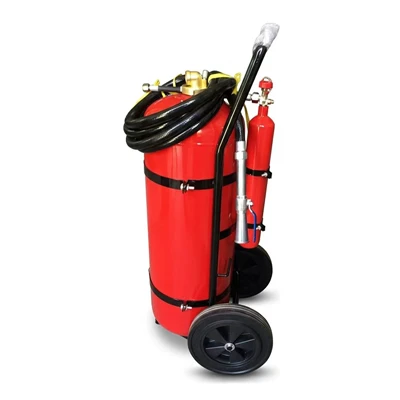
First, let’s clarify what “ABC dry chemical powder” actually is, because a lot of the confusion starts with mixing up common terms or misinformation from non-specialist sources. ABC powder is a monopropellant fire suppression agent, made primarily of monoammonium phosphate (MAP)—that’s the active ingredient, plus small, precise amounts of additives to prevent caking, improve flow, and make it stable. When I source raw materials for our powder, we test every batch to make sure the MAP content is between 90 and 95% by weight, with the rest being things like hydrophobic silica to keep it dry even in humid environments. That composition is non-negotiable; even a 1% shift in additive levels can change how it works when it hits a flame.
Now, to answer the core question: is this powder combustible? The short, tested answer from all the major fire safety standards bodies is no. But let’s unpack that, because “combustible” has a very specific definition in chemistry and fire science—something a lot of random online articles skip. Combustible materials need three things to catch fire: fuel, heat (ignition source), and oxygen, the fire triangle. For a substance to be classified as combustible, it must sustain combustion on its own once an ignition source is removed. That’s the key line.
Monoammonium phosphate, the main component of ABC powder, does not sustain combustion. In fact, it does the opposite: when it’s exposed to flame, it undergoes a chemical reaction that actually puts the fire out. When heated to around 300°F (149°C), MAP breaks down to release ammonia gas and phosphoric acid. The ammonia displaces oxygen at the base of the flame, cutting off one side of the fire triangle, and the phosphoric acid forms a sticky, non-flammable coating over burning fuel (like wood, paper, or plastic) that keeps oxygen from reaching it too. That reaction happens at temperatures way lower than the heat of a typical Class A, B, or C fire—so the powder is designed to react, not burn.
But wait, I’ve seen people post online about “powder dust explosions” from dry chemical agents, and that’s where the confusion comes in. Dust explosions are a real risk, but they’re not the same as the powder itself being combustible. Let’s distinguish here: a dust explosion occurs when very fine particles of a substance (that is itself not combustible in bulk) are suspended in air in a tight concentration and exposed to an ignition source. For example, grain dust isn’t flammable as a whole bushel of wheat, but a cloud of it in a silo can explode if sparked. That’s the case with ABC powder dust, not the solid powder.
I’ve had clients bring this up in meetings, because they’re worried about storing bulk ABC powder in warehouses or even using it on large fire sites. The key here is the difference between bulk material and suspended dust. Our bulk ABC powder is packaged in steel drums or heavy-duty plastic bags, and OSHA’s safety guidelines for bulk storage classify the powder as a non-combustible solid. We’ve done third-party testing every year for 10 years, following ASTM E136, the standard test for non-combustible building materials. The test exposes a sample to 1,832°F (1,000°C) for 10 minutes; our powder doesn’t ignite, doesn’t sustain flame, and only turns slightly gray at the edges, never burning through. That’s not a sign of a combustible product.
Another common myth: since ABC powder puts out electrical (Class C) fires, it’s conductive, which people mix up with combustibility. But the conductivity is a separate property—our powder is treated to be non-conductive with a silicone coating that prevents static buildup, which is why it’s safe to use on live electrical equipment. That’s a safety feature, not a risk, and it has nothing to do with whether the powder itself will burn.
Now, let’s talk about why this confusion matters. If someone thought ABC powder was combustible, they might avoid using it entirely, which is dangerous because it’s one of the most versatile fire suppression agents on the market. It works on Class A (ordinary combustibles like wood, paper, cloth), Class B (flammable liquids like gasoline, oil, propane), and Class C (electrical fires like wiring, servers, panel boxes). That’s why it’s the standard for most office buildings, schools, hospitals, and even residential fire extinguishers in the U.S. and most of Europe.
As a supplier, I’ve seen firsthand what happens when people get bad information about this powder. A small restaurant client of mine last year almost replaced all their ABC extinguishers because a local handyman told them “the powder will catch fire if it gets too hot.” I went to their site, brought test data from our third-party lab, and explained that the powder’s thermal stability is rated to 180°F (82°C) for extended storage—way higher than the temperature inside a typical kitchen cabinet, which rarely goes above 100°F (38°C) even on a hot summer day. The handyman had confused ABC powder with potassium bicarbonate powder, which is used for Class K kitchen fires and has slightly different thermal properties. That’s the kind of mix-up that causes unnecessary risk and cost for small businesses.
I should also address a small caveat, because I don’t want to mislead anyone. While the powder itself isn’t combustible, the additives we use to make it flow well can pose a tiny risk if handled in extremely large quantities with no ventilation. For example, if you were to empty an entire 50-pound bag of ABC powder into a closed, unventilated space and then create a spark strong enough to ignite dust (like a welding arc within inches of the cloud), you could have a small dust flash. But that’s a specific scenario that doesn’t apply to normal use of fire extinguishers, bulk storage, or regular handling. OSHA’s guidelines for handling fine powders warn against any dust cloud—whether it’s flour, sand, or ABC powder—so that’s a general safety rule, not a specific risk with our product.
Let’s back this up with real testing data, because numbers matter more than opinions. Our powder’s flash point, tested per ASTM D93, is greater than 3000°F (1649°C)—for context, gasoline has a flash point of -45°F (-43°C), which is why it’s so flammable. The autoignition temperature of MAP alone is around 750°F (399°C), which is way higher than the temperature of most common ignition sources. A lit match is around 1,100°F (593°C), but that only ignites paper or wood because those materials break down into flammable gases when heated. ABC powder doesn’t release those flammable gases, so even at 750°F, it doesn’t catch fire on its own.
Another point: when the powder is discharged from an extinguisher, it’s designed to disrupt the fire’s chemical chain reaction, not to feed it. If you’ve ever used an ABC extinguisher, you know it leaves a fine, powdery residue on surfaces. That residue is non-combustible, so cleaning it up isn’t a fire hazard. We’ve tested the residue left after suppressing a Class B gasoline fire; it doesn’t burn when exposed to a lighter flame, which is proof the powder didn’t contribute to the fire at all.
As someone who’s been in this business for over a decade, I’ve worked with hundreds of fire safety professionals, and the only people who claim ABC powder is combustible are either repeating old misinformation or confusing it with other dry chemical agents. For example, BC powder uses sodium bicarbonate instead of MAP, and it has slightly different thermal properties, but that’s a different product. ABC is specifically formulated to work on all three fire classes, and its composition is strictly regulated by NFPA (National Fire Protection Association) standards 10 and 17, which govern fire extinguishers and suppression systems.
So why does this matter for you, whether you’re a business owner, facilities manager, or homeowner? Because knowing the truth about ABC powder’s properties helps you make safe, informed decisions about your fire protection. If you’re choosing between fire extinguishers, you don’t have to worry about the powder itself being a fire risk—you just need to use the right size for your space, store it properly, and have it inspected annually. And if someone tries to tell you otherwise, ask them for test data or references to NFPA, OSHA, or ASTM standards, not random blog posts or hearsay.
At the end of the day, ABC dry chemical powder is one of the most reliable fire suppression tools ever developed, and its non-combustible nature is a big part of why it’s so widely used. It doesn’t catch fire, it doesn’t feed fires, and it’s safe to use in almost every indoor and outdoor setting. If you’re looking to upgrade your fire protection system, or you have questions about bulk ABC powder for storage or industrial use, our team can walk you through test data, storage guidelines, and product specifications to make sure you get the right solution for your needs. We work with businesses of all sizes, from small retail shops to large manufacturing facilities, and we prioritize safety above all else—because that’s what this industry is all about.
If you’d like to learn more about our ABC dry chemical powder, including pricing, bulk ordering, or safety training resources, our team is available to connect with you at your convenience. We’re happy to answer any additional questions you have, from thermal stability testing to application recommendations for specific fire hazards.
Nitrile Fire Hose References
National Fire Protection Association. (2023). NFPA 10: Standard for Portable Fire Extinguishers.
ASTM International. (2022). ASTM E136: Standard Test Method for Behavior of Materials in a Vertical Tube Furnace at 750°C.
Occupational Safety and Health Administration. (2021). Safety and Health Topics: Combustible Dust.
ASTM International. (2021). ASTM D93: Standard Test Methods for Flash Point by Pensky-Martens Closed Cup Tester.
Shaoxing Weimin Fire Fighting Equipment Co., Ltd.
Shaoxing Weimin Fire Fighting Equipment Co., Ltd. is one of the most professional abc dry chemical powder manufacturers and suppliers in China, also supports customized service with low price. Welcome to buy discount abc dry chemical powder in stock here and get quotation from our factory. 5 years warranty is available.
Address: CHINA
E-mail: info@weiminfire.com
WebSite: https://www.weiminfire.com/
