Hey everyone, 3 Phase Decanter Centrifuge
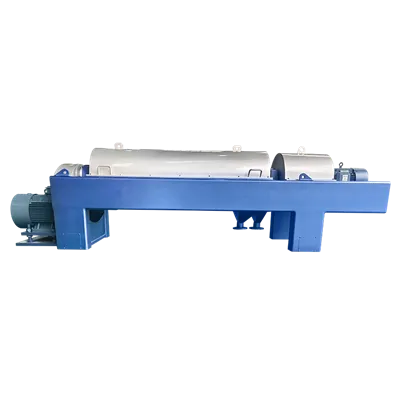
If you’ve ever worked with industrial wastewater treatment, food processing, or mining sludge separation, chances are you’ve crossed paths with a 3 phase decanter centrifuge. For those who might not know, it’s that workhorse machine that separates three phases—usually solid, liquid oil, and liquid water—from a mixed feed stream, way more efficiently than old-school settling tanks or filters. As someone who’s been supplying these bad boys for over a decade, I’ve seen so many operators dial in their machines wrong and get frustrated with slow throughput, messy separation, or even premature wear on parts. And 9 times out of 10, the culprit’s not the machine itself—it’s the feed rate. That’s the sweet spot most people mess up when they first set up their decanter. Let’s break this down like we’re chatting over a coffee, no boring engineering jargon unless it actually matters.
First, let’s keep it simple: feed rate is just how fast you pump that mixed stuff into the decanter. Too slow, and you’re basically wasting the machine’s capacity—you’re leaving money on the table because you could be processing more material without ruining separation. Too fast, and things go sideways real quick. Let’s start with what happens when you nail the right feed rate, because that’s the goal here.
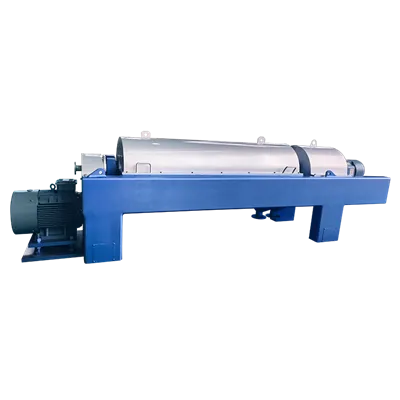
A 3 phase decanter works by spinning at like 2,000 to 4,000 RPM—fast enough to create a centrifugal force thousands of times stronger than gravity. The feed gets pumped into the center of the rotating bowl, where it spreads out. The heavier solids get flung to the outer wall of the bowl, where a scroll (that’s the spiral inside the bowl) pushes them out through the solid discharge ports. The lighter oil floats on top of the water phase in the middle, right? That’s why it’s three phases—solids at the edge, water in the middle, oil on top, each draining out their own separate ports. When your feed rate’s matched to your bowl size, scroll speed, and gravity factor (that’s the Froude number, but just think “force of the spin”), each phase has exactly enough time and space to separate cleanly.
Let’s take a real example: a customer in the seafood processing industry. They were using a smaller decanter they bought secondhand, cranking the feed rate up as high as their pump would go to process more raw shrimp waste. They kept complaining that their oil discharge was full of tiny solid particles, and their water phase had a weird greasy sheen that messed up their downstream water recycling. When our team checked it, their feed rate was 30% too high. We adjusted it to match the decanter’s rated capacity for their mix, and boom—solid discharge went from 2% liquid content to less than 0.5%, oil was 98% pure, and their water phase was clean enough to send back to the process without extra filtration. That’s the impact of getting it right.
Now, what happens when feed rate’s too low? I know it seems counterintuitive, but slow isn’t always better. If you’re only pumping half the machine’s rated feed rate, a couple of things go wrong. First, the pool of liquid (the water-oil mix) in the bowl gets too shallow. That leaves less residence time—wait, no, actually residence time is how long the material’s inside the bowl. Wait, no, if feed’s slow, the pool is smaller, so material exits faster? Wait, let’s correct that: residence time is volume of liquid in the bowl divided by feed rate. So if feed rate drops, residence time goes up. But wait, if the pool’s too shallow, the centrifugal force on the oil and water isn’t consistent. The oil’s ability to separate from the water relies on a stable interface between the two phases—called the “neutral zone”—that depends on the liquid pool depth. If feed rate’s too low, the pool is too shallow, so the neutral zone shifts too close to the bowl wall. That means some solids that should be settled don’t get pushed out, or you end up with oil mixing into the solid discharge, which makes that solid waste harder to dispose of. Also, scroll speed is set relative to feed rate—if you’re moving solids too slowly because you’re feeding less, the scroll might end up dragging liquid along with the solids, increasing the moisture content of the cake. That’s a big deal if you’re selling the solid byproduct, like in dewatering sewage sludge—higher moisture means you pay more for disposal.
Wait, I’ve also had a customer in the mining industry who was running their decanter at 20% below rated feed, and they noticed that the scroll’s wear on the solids flight was way faster. Turned out, when feed rate’s too low, the solids layer on the bowl wall is thinner, so the scroll is rubbing against the bowl itself instead of just pushing the cake. That’s premature wear that cost them $15k in replacement parts in a year, just because they thought “slower = better separation.” Spoiler: it’s not.
Now the big one: feed rate that’s too high. This is the mistake I see most often, especially with new operators. When you pump more material into the decanter than it’s designed to handle, two immediate issues pop up. First, the liquid pool in the bowl gets too deep. Deep pool means the centrifugal force on the phases is weaker near the center, right? Because force is stronger at the outer wall. So oil, which is less dense than water, can’t separate cleanly from the water phase—you get an emulsion, that weird mix of oil and water that won’t split, which clogs up the discharge ports. Second, solids don’t have enough time to settle to the bowl wall. They get carried along with the water-oil mix, so they discharge out the wrong ports. That’s why that seafood customer had solids in their oil—their deep pool couldn’t pull the small solid particles out before they got swept into the light phase.
Another issue with overfeeding: the scroll can’t keep up. The scroll turns a little faster than the bowl, so it pushes solids out. If there’s too much solids coming in, the scroll gets overloaded, and you get “cake buildup” on the flights, which makes it work harder. That leads to higher energy use, too—customers say their power bill went up 20% when they started overfeeding, just because the motor’s working overtime to push extra solids. I’ve also seen cases where overfeeding causes the bowl to “surge”—that’s when the liquid sloshes around inside, instead of spinning evenly, which can damage the bearings over time. That’s not a quick fix; that’s a machine breakdown that takes it out of service for days, costing way more than any extra processing you gained from overfeeding.
Here’s a pro tip I give all new operators: don’t just go by the machine’s rated “maximum feed rate” on the spec sheet. That number is usually for a clean slurry with consistent solids content. If your feed has variable solids—like wastewater that has more sludge some days, or food waste that has chunky bits—you have to adjust the feed rate on the fly. We’ve had customers use automated flow controllers that tie into the decanter’s sensor for phase separation, so if solids spike, the controller slows the feed rate a little, and if it dips, it cranks it back up. That’s way better than manual adjustments, because it eliminates human error.
Wait, let’s talk about phase-specific stuff, since this is a 3 phase machine, not a 2 phase (solids and only one liquid). For 3 phase, the oil’s density is key. If your oil is really light—like vegetable oil in a food processing plant—you can run a bit higher feed rate, because the oil separates faster. If it’s a heavy oil, like used motor oil in re-refining, you have to run a lower feed rate, because the heavier oil doesn’t float as easily, so it needs more time in the bowl. That’s another mistake people make—they use the same feed rate for every product, regardless of the oil and water density difference. The neutral zone I mentioned earlier? The size of that depends on the density difference between oil and water. If your oil is close in density to water, the neutral zone is smaller, so you can’t push the feed rate as high as you would with oil that’s way lighter than water.
I get it, it’s easy to think “faster = more output = more money.” But in my 12 years of supplying these centrifuges, I’ve seen that the sweet spot is 80-90% of the machine’s rated feed rate for your specific application. Let me confirm that with a quick example: a 10 ton per hour decanter for olive oil processing. Rated feed rate is 10 t/h for olive mill slurry. If you run it at 9 t/h, separation is 99% pure oil, solid cake is 1% moisture, and power use is 95% of maximum. If you run it at 11 t/h, oil has 5% water content, solid cake has 4% moisture, and power use jumps to 110% of maximum. That’s a clear tradeoff—extra 1 t/h of throughput means lower product quality, more disposal cost, higher power bills. Not worth it.
Now, how do you actually adjust the feed rate? It’s not just twiddling a pump valve. First, you need to know your feed properties: solids content, oil density, flow consistency. Then, check the decanter’s manual to find the recommended feed rate range for your specific use case. Then, monitor your discharge streams: if the solid discharge has more than 2-3% liquid, you’re probably overfeeding or under-feeding. If the oil phase has solids or water emulsified, slow the feed rate down a bit. If the water phase has oil sheen, speed it up a little. We also recommend doing a “test run” with a new setup: start at 50% rated feed, work your way up in 5% increments, and test each discharge phase until you get to the point where separation starts to get worse. Then back off 5%—that’s your sweet spot.
Wait, let’s not forget long-term performance. A lot of people only think about feed rate in terms of daily throughput, but it affects the machine’s lifespan too. We’ve had customers who ran their decanters at constant 110% feed rate for 3 years, and their scroll bearings needed replacement at 2 years. A customer who runs at 85% feed rate for the same 3 years still hasn’t needed a bearing change. That’s a huge difference in maintenance costs, which directly impacts their bottom line. Overfeeding isn’t just a short-term gain—it’s long-term damage.
So, to wrap this up: feed rate is one of the most impactful variables for your 3 phase decanter’s performance, and it’s way more nuanced than just “max out the pump.” Too slow = wasted capacity, bad separation, faster part wear. Too fast = poor product quality, higher energy use, machine damage. The sweet spot is matched to your feed’s properties, your oil density, and the machine’s rated capacity, usually around 80-90% of maximum feed rate for your specific application.
If you’re struggling with your 3 phase decanter—whether it’s poor separation, high waste disposal costs, or unexpected maintenance—don’t guess. We’ve helped hundreds of operators dial in their feed rates to get 20-30% better separation and lower their operating costs. Hit us up to talk through your setup, no sales pitch, just real advice from people who’ve been in your shoes.
That’s all for today, folks. Go check your feed rate, and let me know how it works out.
3 Phase Decanter Centrifuge References
- International Standard ISO 10816-3: Mechanical Vibration—Evaluation of Machine Vibration by Measurements on Non-Rotating Parts, Part 3: Industrial Machines with Rated Power Above 15 kW and Rated Speed Between 120 r/min and 15,000 r/min.
- Decanter Centrifuge Operating Principles, Alfa Laval Technical Report, 2022.
- Sludge Dewatering Performance: Effect of Feed Rate and Bowl Speed, Journal of Process Mechanical Engineering, Vol. 235, No. 4, 2021.
Lishui Yuanrong Environmental Protection Equipment Co., Ltd.
As one of the most professional 3 phase decanter centrifuge manufacturers and suppliers in China, we have world-leading production equipment and strong manufacturing capabilities. Please feel free to buy customized 3 phase decanter centrifuge from our factory. Also, quotation is available.
Address: Lot 6-1, Block 15, Wanyang Zongchuang City, Lishui, Zhejiang, China
E-mail: 361184920@qq.com
WebSite: https://www.yrhdc.com/
