If you’ve ever walked through a materials testing lab, a metal fabrication shop, or a ceramic manufacturing facility, you’ve probably seen a large, heavy oven with touchscreen controls, adjustable heating ramps, and precise temperature readouts tucked in a corner or along a production line. That’s often a programmable box furnace—one of the most versatile tools in thermal processing, and the backbone of hundreds of industrial and research workflows. As a supplier of box furnaces, I get asked all the time: what exactly makes a programmable box furnace different from a standard lab oven or a basic industrial heater? It’s not just the name. Let’s break it down simply, from how it works to why it matters for everything from sintering ceramics to heat treating metal. Box Furnace
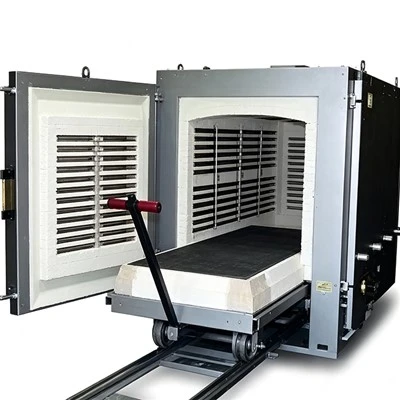
First, let’s start with the basics: a box furnace, at its core, is a batch-type thermal processing unit. Unlike continuous furnaces that move parts through a long, heated tunnel, a box furnace has a sealed, insulated chamber that you load, close, process, and unload in batches. It’s shaped like a large box (hence the name) and insulated with refractory materials—things like ceramic fiber, mineral wool, or high alumina brick that can withstand extreme heat without transferring too much energy. That insulation is key, because it keeps the heat inside where it’s needed, cuts down on energy waste, and protects the surrounding workspace from excessive temperatures.
Now, the “programmable” part is what sets it apart from a standard oven or a non-programmable furnace. A non-programmable heater might just turn on to a set temperature, stay there, and turn off when you’re done. A programmable box furnace has a built-in controller that lets you map out an entire heating, holding, and cooling cycle step by step, right from the touchscreen panel. You can set things like how fast the temperature ramps up (called a ramp rate), how long it holds at a specific temperature (a soak), and how quickly it cools back down. You can even repeat cycles or link multiple steps together to create complex, custom profiles.
Let’s use a real example to make this concrete. Say you’re a small ceramic artist testing a new porcelain glaze. If you put your pieces in a standard toaster oven, you might heat it fast to 1,200°C, but that rapid heating would cause the glaze to crack or the porcelain to warp. A programmable box furnace, though, lets you set a ramp rate of 5°C per minute up to 800°C, hold there for two hours to slowly dry out any remaining moisture (called debinding, a critical step for ceramics), then ramp up to 1,260°C at 3°C per minute, hold for three hours to melt the glaze evenly, and finally slow cool at 2°C per minute to avoid thermal shock. That’s the kind of precise control that only a programmable system can deliver—and it’s why hobbyists, labs, and manufacturers rely on them.
Beyond ceramics, programmable box furnaces are used across dozens of industries. In metal fabrication, they’re used for heat treating: processes like annealing, which softens metal to make it easier to machine, or tempering, which reduces brittleness after hardening. For a machinist making small metal parts, a programmable furnace can set a slow heat to 750°C, hold for an hour, then cool in a controlled way that ensures the part retains its strength without cracking. In materials science labs, researchers use them to test new composites—mixing carbon fibers with polymer resins, then heating in a box furnace to cure the resin and form a strong, lightweight material for aerospace or automotive parts. Even in battery manufacturing, box furnaces are used to sinter electrode materials, a process where powder is compressed and heated to fuse the particles together without melting the whole structure.
Now, let’s talk about the parts that make a programmable box furnace work, because it’s not just a controller. The heating elements are usually made of nickel-chromium alloys for lower temperature applications (up to around 1,200°C) or silicon carbide or molybdenum disilicide for high-temperature models that can go above 1,800°C. Those elements are evenly spaced along the walls, floor, and sometimes ceiling of the chamber to ensure uniform heat distribution—no cold spots where parts might not process correctly. The chamber is often lined with a heat-resistant lining, and the door is sealed with a gasket to prevent heat leakage, especially when processing at high temps.
The controller itself is the brain. Modern programmable box furnaces have user-friendly interfaces that let you save and name multiple cycles—so a lab can have a “ceramic glaze cycle,” a “metal annealing cycle,” and a “sample testing cycle” all ready to go, no need to re-program every time. Many also have data logging capabilities, so you can track every step of the cycle, document temperature changes, and even export that data for quality control purposes. For regulated industries like medical device manufacturing or aerospace, that data is non-negotiable—you need to prove your parts were processed correctly.
Another feature that’s common in programmable box furnaces is the ability to run under different atmospheres. Some processes need to be done in air, but others (like sintering certain metals or preventing oxidation) require an inert atmosphere like nitrogen, argon, or even a vacuum. Programmable furnaces can be fitted with gas inlet and outlet ports, so you can purge the chamber with gas before starting the cycle, and adjust gas flow during heating or cooling. That’s a big difference from older box furnaces that only ran in air, limiting their use cases.
I’ve been selling box furnaces for more than a decade, and one thing I’ve learned is that the best programmable box furnace isn’t the one with the most features—it’s the one that matches your specific needs. A high-temperature furnace that goes to 1,800°C is overkill for a small pottery studio that only works up to 1,300°C, and a low-temperature unit won’t work for a metal shop doing heat treating. That’s why we work with every customer to walk through their workflow: what materials they’re processing, what temperatures they need, what cycle complexity they require, and whether they need atmosphere control or data logging.
A common mistake new buyers make is thinking they need to over-spec their furnace to “be safe.” But a furnace that’s too large for their batches will waste energy—heating a big empty chamber is a huge cost, both in electricity and wear on the heating elements. On the flip side, a furnace that’s too small means you can only process a few parts at a time, slowing down production. That’s why taking measurements of your typical batch size and mapping out your process steps before buying is so important.
Another point to consider: durability. A good programmable box furnace should last 15 to 20 years with regular use, if it’s built with quality materials. Cheaper models might use thin insulation or low-grade heating elements that fail after a few hundred cycles, leading to downtime and replacement costs. We build our furnaces with thick, dense refractory linings, heating elements rated for thousands of hours of use, and controllers that are easy to repair or update, not disposable.
Let’s also address a question I get all the time: is a programmable box furnace the same as a muffle furnace? Sometimes people use the terms interchangeably, but there’s a small difference. A muffle furnace is a type of box furnace where the chamber is separate from the heating elements—usually a metal or ceramic muffle that sits inside the insulated box. That design is good for preventing contamination, because the parts you’re processing never touch the heating elements or insulation. For many applications, though, a standard programmable box furnace with elements directly on the chamber walls works just as well, and is more energy efficient.
So why does all this matter? For small labs, a programmable box furnace turns a one-off job into a repeatable, reliable process. For manufacturers, it’s the difference between consistent parts that meet specs and batches that have defects, wasting time and money. For researchers, it’s a tool that lets them test new ideas, iterate quickly, and turn lab-scale experiments into production-ready processes.

If you’re looking to add a programmable box furnace to your workflow—whether you’re a hobbyist expanding your ceramic projects, a materials lab testing new composites, or a manufacturer optimizing heat treating processes—we’re here to help. We don’t sell one-size-fits-all units; we work with you to understand your needs, recommend the right size, temperature range, and features, and provide support from installation to ongoing maintenance. Don’t waste time on units that don’t match your process or features you’ll never use. We can walk you through your options, answer any questions, and help you pick a furnace that works for your budget and your long-term goals. Reach out to our team to discuss your requirements and start the process of finding the right programmable box furnace for your operations.
Nitriding Furnace References:
- “Industrial Thermal Processing: A Guide to Furnace Technologies” – Industrial Heating Magazine, 2022
- “Ceramic Manufacturing Processes: Sintering and Firing” – Journal of the American Ceramic Society, 2021
- “Heat Treating Fundamentals for Metal Fabricators” – ASM International, 2020
- “Programmable Control Systems for Thermal Processing” – International Journal of Advanced Manufacturing Technology, 2019
Jiangsu Fangwei Furnace Industry Co., Ltd.
Jiangsu Fangwei Furnace Industry Co., Ltd. is one of the most professional box furnace manufacturers and suppliers in China. With abundant experience, we are committed to providing high quality customized products with competitive price. Please feel free to buy advanced box furnace made in China here from our factory.
Address: No.168, HuangNian Bridge, DaoShu Town, Danyang City, JiangSu Province, China
E-mail: fangwei@fwfurnaces.com
WebSite: https://www.fwfurnaces.com/
